
Mar. 30, 2026
On-site self-calibration of sensors by users is generally not recommended, as it requires professional equipment and environment. However, in certain cases (such as long-term inactivity, suspected accuracy degradation after transportation, etc.), simple calibration can be performed to verify the equipment status.
One 1KG weight, one 5KG weight, and a spirit level.
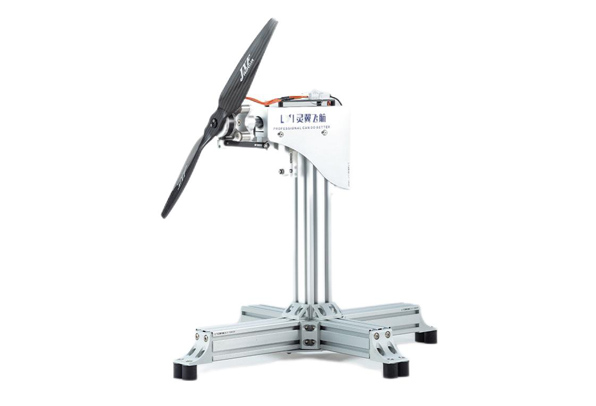
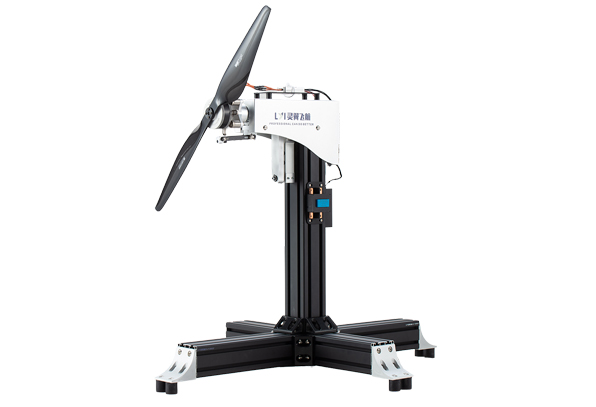
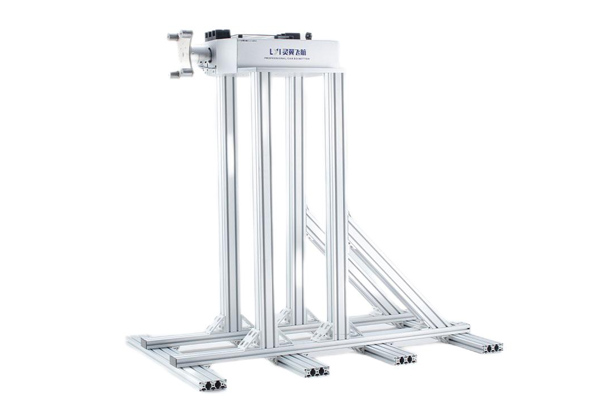
Flip the test bench 90° horizontally and fix it firmly, with the motor mounting base facing directly upward.
Use the spirit level to calibrate the levelness of the head plane (within 0.2mm/m in both cross directions).
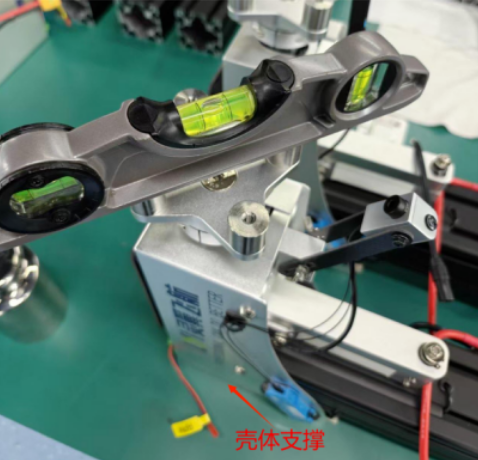
FIG-1 Calibrate the head levelness with a spirit level
The host computer performs a thrust zero reset, then places 1 kg and 5 kg standard weights on the motor mounting base respectively (the weights should be placed as centrally as possible), and compares the measured values with the readings displayed on the host computer.
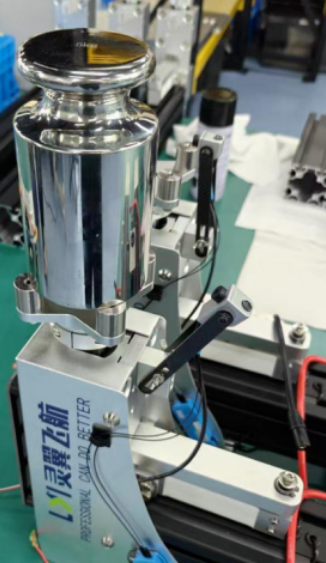
FIG-2 Load weight
①:For measurement deviations below 10g, it is not recommended to make adjustments, and the calibration parameters at the factory should be used as the standard.
②:If there is a significant deviation (>10g) between the measured data and the weight of the weight, and there is a linear relationship, the manufacturer can be contacted to recalculate the thrust coefficient based on this measurement value.
③:If the deviation is large and irregular, you can unplug the plug of the thrust sensor and observe the reading on the upper computer. If the reading is greater than 5000g, it indicates that the thrust sensor is damaged and needs to be repaired by contacting the manufacturer.
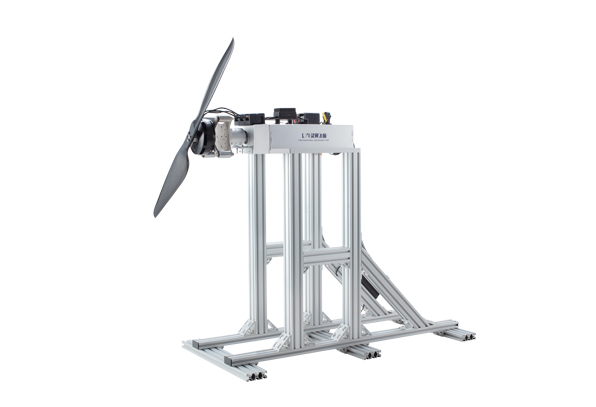
The shell is only fixed to the frame profile by 2 bolts. When horizontally supported by the test bench shell (as shown in the above figure), do not load weights of more than 5kg on the head!
matching torque rod, level, one 1KG and one 5KG weight each.
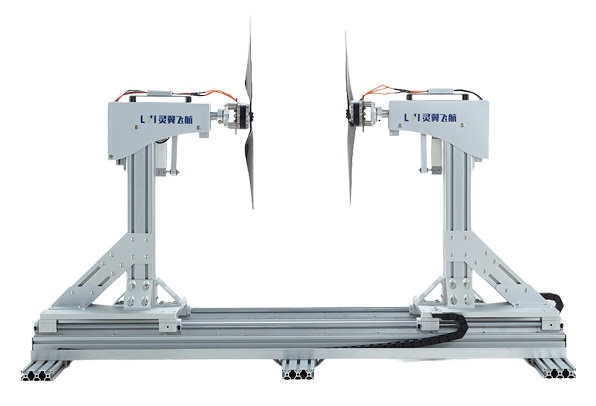
Fix the test bench to ensure that the spindle direction is parallel to the horizontal plane.
It is recommended to level the top of the two linear bearing seats after removing the shell, and the levelness of the main shaft relative to the horizontal plane should be within 0.2mm/m.
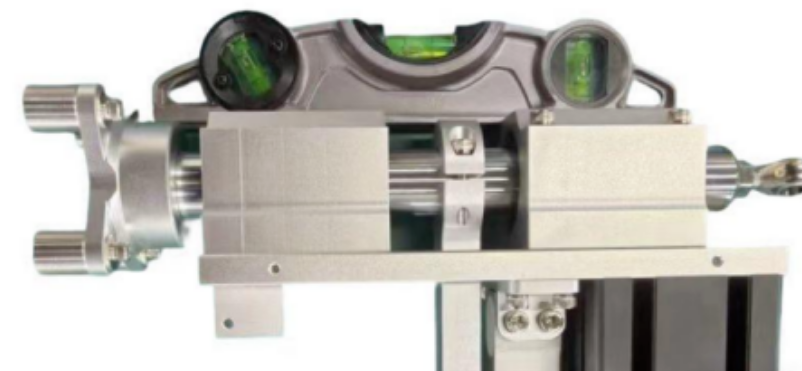
FIG-3 Benchmark leveling
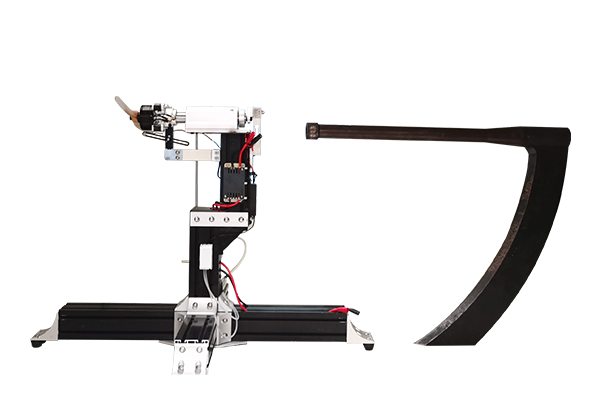
Install a torque rod on the motor mounting bracket;
The upper computer performs torque reset, and then loads 1KG and 5KG standard weights (corresponding to torques of 2Nm and 10Nm) at 203.94mm on the torque plate, and compares the measured values with the upper computer readings;
①: For measurement deviations below 0.01Nm, it is not recommended to make adjustments, and the calibration parameters at the factory should be used as the standard.
② If the measured data deviates significantly from the actual torque (>0.01Nm) and shows a linear relationship, the manufacturer can be contacted to adjust the torque coefficient.
③ If the deviation is large and irregular, you can unplug the plug of the torque sensor and observe the reading on the upper computer. If the reading is greater than 10Nm, it indicates that the torque sensor is damaged and needs to be repaired by contacting the manufacturer.
Operation steps for multi-meter:
After powering on the device, use a multimeter to measure the power supply voltage of the ESC;
Comparing with the displayed voltage value on the upper computer, it is recommended to calibrate in the following way:
① If the voltage level used on site is relatively fixed, such as 40-60V, it is recommended to use 40V and 60V as benchmarks for targeted calibration, which can obtain more accurate measurement data within this range.
② If the range of use is broad and the detected voltage deviation is small (≤ 1V), calibration is not recommended.
If there is no change or abnormal fluctuation in the current, please check the wiring and contact the manufacturer for handling.
Ammeter
Connect the ammeter to the DC power circuit and set the host computer sampling frequency to 10Hz.
Operate the motor at 30% throttle. After the current stabilizes, record the current readings of the ammeter and the host computer (multiple measurements are recommended for averaging).
Operate the motor at 100% throttle. After the current stabilizes, record the current readings of the ammeter and the host computer (multiple measurements are recommended for averaging).
Compare the deviation under different current working conditions:
① If the current deviation is within 5%, adjustment is not recommended, and the factory calibration parameters shall prevail.
② If the current deviation exceeds 5%, calculation can be performed according to the method in the appendix, and the manufacturer shall be contacted to modify the calibration parameters.
③ If the current remains unchanged or fluctuates abnormally, check the wiring and contact the manufacturer for troubleshooting.
Note: Although the motor runs smoothly, current fluctuation still exists during operation. Therefore, the above method is recommended for verification purposes only.
Ensure the test bench is in an environment with stable temperature before calibration (recommended: 20±5℃).
Use standard weights and instruments that have passed metrological certification.
Avoid vibration and air flow interference during the calibration process.
Record complete calibration data to facilitate traceability and analysis.
A password is required to modify the calibration coefficients—please contact the manufacturer's technical support.
It is recommended to conduct accuracy verification every 6 months;
Conduct professional calibration once a year (can be returned to the factory or completed by a professional organization);
Keep the sensor clean and prevent dust and foreign objects from entering;
Regularly inspect the connecting cables and connectors;
When not in use for a long time, it is recommended to cover it with a dust cover.
Technical Support by WingFlying
If you require professional calibration services, system diagnostics, or customized UAV power system test solutions, WingFlying provides reliable technical support and engineering assistance. Please contact our team for further guidance.


E-mail: 18722591228@163.com
Add.: 7th Floor, B2#,Animation Building, Sino-Singapore Tianjin Eco-City